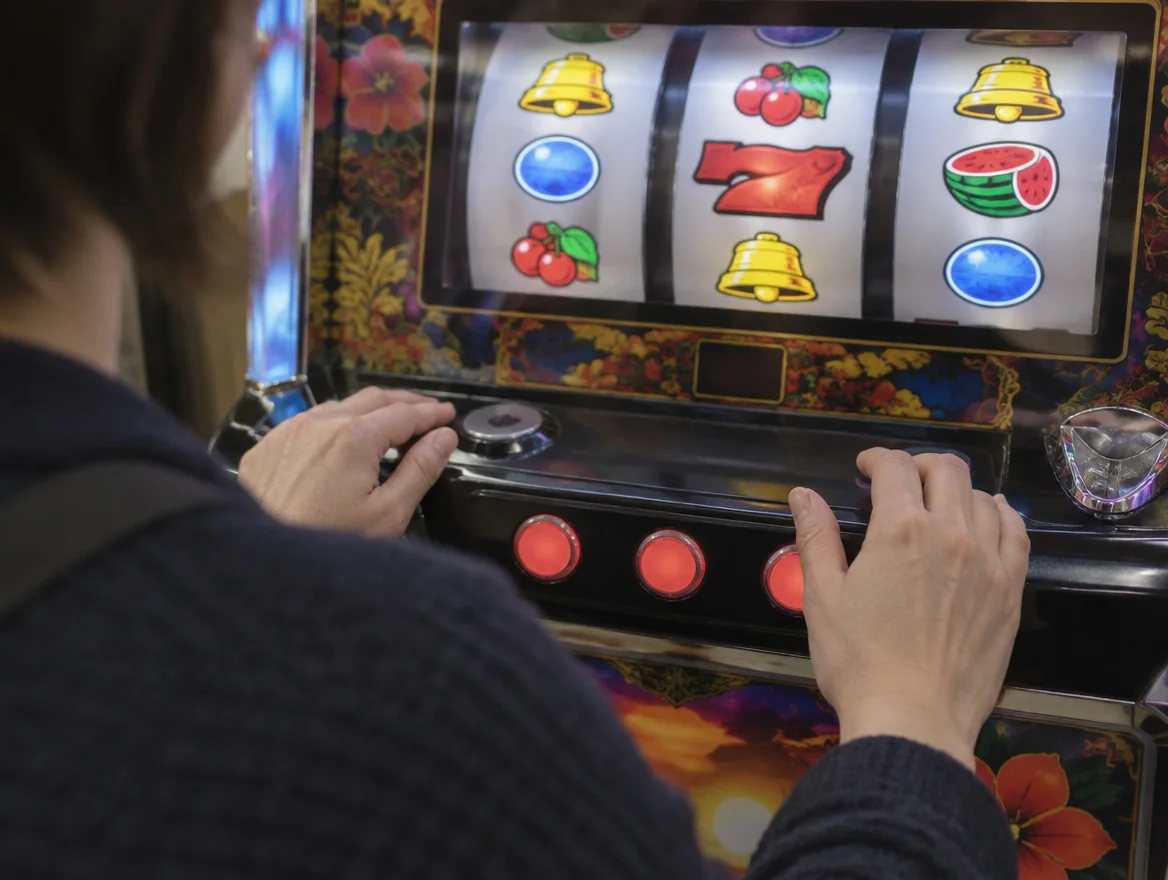
Every pachislot looks alike from the aisle: three reels, a lever, three stop buttons. Inside, though, there are two very different “engines”. One pays mostly through bonuses (A-type), the other through an assist mode (AT, and the older ART). Knowing which is which tells you what the flashing screen is trying to say.
If you’ve never played, start with how to play pachislot.
At a glance
| A-type (Aタイプ) | AT (アシストタイム) | ART (アシストリプレイタイム) | |
|---|---|---|---|
| Main payout | Real bonuses: BIG and REG | Push-order assistance for medal-paying symbols | Assistance plus a replay-heavy state |
| What you watch | A lamp or reel signal, then line up 7s or BARs | Screen arrows (e.g. 中→左→右) telling you the stop order | Same as AT, with bonuses mixed in |
| Pace | Steady, simple | Long build-ups, then fast runs | Medium |
| Typical example | Juggler series (Kitadenshi) | Most modern anime smart slots | Many 5th-generation hits (2007–2018) |
| Japanese Wikipedia era notes | “Normal” machines across every era | Boomed in the 4th generation, returned in the 5th and 6th | Rose after 2007, dominant in the 2010s |
Sources for the era notes: ja.wikipedia パチスロ (secondary).
A-type: the classic
An A-type pays mainly through real bonuses decided by the internal draw:
- BIG bonus (BB): the larger bonus.
- REG bonus (RB): the smaller one.
On a Juggler machine, the GOGO! lamp lights when a bonus has been drawn, and you then line up the symbols to collect it. Kitadenshi’s official table for My Juggler V lists a separate BIG and REG probability for each of the six settings. At setting 1, for example, they are 1/273.1 and 1/409.6 (Kitadenshi).
DMM’s English beginner guide suggests the Juggler series for first-timers because the system is simple (DMM). More options are in beginner-friendly machines.
Newer A-types. Under the latest (6.6) rules, Japanese Wikipedia describes a “Bonus Trigger” (規定数固定機能) for normal machines. Bonus odds are much higher on 1- or 2-medal games than on 3-medal games, the machine decides the bet (the player can’t choose), and AT or RT features aren’t allowed (ja.wikipedia 6号機 (パチスロ)). TODO: confirm with a maker’s or DMM’s explainer.
AT: Assist Time
In normal play, an AT machine draws small roles (bells, replays, cherries…) on every game. Some medal-paying roles only pay if you stop the reels in the right order. During AT, the screen tells you that order (押し順ナビ, oshijun navi), so you collect them. That’s where the medals come from.
What you’ll see:
- CZ (Chance Zone): a short challenge that may lead into AT.
- AT start (AT突入): the main mode begins. Follow the arrows.
- Upper AT (上位AT): a stronger version on some machines.
- Ceiling (天井): a game-count limit some machines have. See ceilings explained.
Japanese Wikipedia notes that under the 6th-generation rules (2018 on), a voluntary industry cap of 3 medals per game net during AT/ART was dropped. Some machines now pay up to around 10 per game during AT (ja.wikipedia). Most of today’s anime smart slots are AT machines. See smart slot explained.
ART: Assist Replay Time
ART combines push-order assistance with RT (replay time), a state where replays come often, so you spend fewer medals per game. Japanese Wikipedia credits ART machines with reviving pachislot from around 2010. It lists examples such as Eureka Seven (Sammy, 2009), Oshi! Bancho 2 (Daito, 2011) and SLOT Madoka Magica (2013) (ja.wikipedia). Today ART is mostly something you’ll meet in collector machines for home (buying guide).
How to tell which type you’re looking at
- The top panel or data counter, which often lists “BIG / REG” counts. Lots of BIG/REG counting usually means an A-type (data counter guide).
- The screen. A big LCD covered in CZ/AT menus means an AT machine. A simple lamp means an A-type.
- The name prefix. “L” or スマスロ marks a smart slot (most are AT). “S” marks a medal machine (PachiPass glossary).
- Ask staff: “Kore wa A-taipu desu ka?” (Is this an A-type?) More in pachinko Japanese.
Quick answers
What is an A-type pachislot?
A machine where most of the payout comes from 'real' bonuses (BIG and REG) rather than an assist mode. The Juggler series is the best-known example: a lamp lights up, you line up the 7s, and the bonus pays out.
What does AT mean on a pachislot?
AT stands for Assist Time, a mode where the screen tells you which order to stop the reels in, so you collect the medal-paying symbols. On most modern machines AT is the main way medals are paid out.
What is ART in pachislot?
ART (Assist Replay Time) combines push-order assistance with a 'replay time' state, where replays come often so you spend fewer medals. It peaked in the 5th-generation era (roughly 2007–2018) and is rarer today.
Which type is easiest for beginners?
Many Japanese beginner guides point first-timers to A-type machines like Juggler, because there's less to follow on screen. That's about simplicity, not about winning. Every type is designed so the parlour comes out ahead over time.
Sources
- ja.wikipedia – パチスロ (machine eras, ART/AT history, representative machines; secondary source)
- DMM Pachitown – Pachislot beginner's guide (recommends Juggler)
- DMM Pachitown – 6号機 explained (Japanese)
- Kitadenshi – My Juggler V official spec table
- Sammy – smart pachislot official explainer (Japanese)
- ja.wikipedia – 6号機 (パチスロ) (6th-generation rules; secondary source)
Facts on this page were last checked against these sources on 4 October 2026. Rules, prices and venues change, so always follow the signs and staff at the venue.